People in the Kieber Lab

Research Scientists

Jamie Winshell
[email protected]
If you need to reach the Kieber Lab for any reason, please contact Jamie Winshell at [email protected], or by phone at 919-962-4448. Our shipping address is Kieber Lab, UNC at Chapel Hill, Genome Sciences Building 4144, 250 Bell Tower Drive, Chapel Hill, NC 27599. Our campus mailbox number is CB3280.
[email protected]
If you need to reach the Kieber Lab for any reason, please contact Jamie Winshell at [email protected], or by phone at 919-962-4448. Our shipping address is Kieber Lab, UNC at Chapel Hill, Genome Sciences Building 4144, 250 Bell Tower Drive, Chapel Hill, NC 27599. Our campus mailbox number is CB3280.
Postdoctoral Researchers

Ria Khare
[email protected]
Ethylene is a key plant hormone that integrates developmental and environmental signals to regulate growth, root development, and stress responses. My research centers on how ethylene signaling pathway regulates root development in Arabidopsis. I used ethylene signaling mutants and time-based expression studies along with a transcriptomics approach to identify genes modulated in response to ACC (precursor of ethylene) and identified a mechanism controlling root development in the absence of ethylene.
[email protected]
Ethylene is a key plant hormone that integrates developmental and environmental signals to regulate growth, root development, and stress responses. My research centers on how ethylene signaling pathway regulates root development in Arabidopsis. I used ethylene signaling mutants and time-based expression studies along with a transcriptomics approach to identify genes modulated in response to ACC (precursor of ethylene) and identified a mechanism controlling root development in the absence of ethylene.
Graduate Students
|
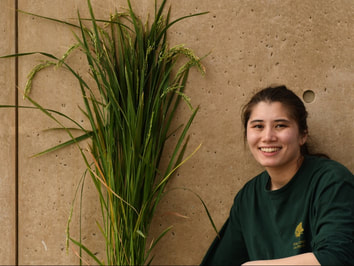
Eva Shouse [email protected] I am interested in cytokinin signaling in rice. My work focuses on the function of the histidine kinases, which serve as cytokinin receptors. I am using a suite of CRISPR knockouts in the HK genes in rice to parse the function of each HK gene in both vegetative and reproductive development. Naveen Kaur Chana
[email protected] Land plants adapt to their environment through morphological changes driven by directional growth, which is accomplished through expansion of the cell wall. The arrangement of load-bearing cellulose microfibrils within the cell wall determines the dimensions of wall expansion. I use genetic, cell biological, and biochemical approaches in the model plant Arabidopsis thaliana to investigate how the protein SHOU4 inhibits Cellulose Synthase (CESA) exocytosis to negatively regulate cellulose deposition. |
Rotating Students
Undergraduate Researchers
|
|
|